How AI Actually Runs a Small Business
Not the version you keep hearing about.
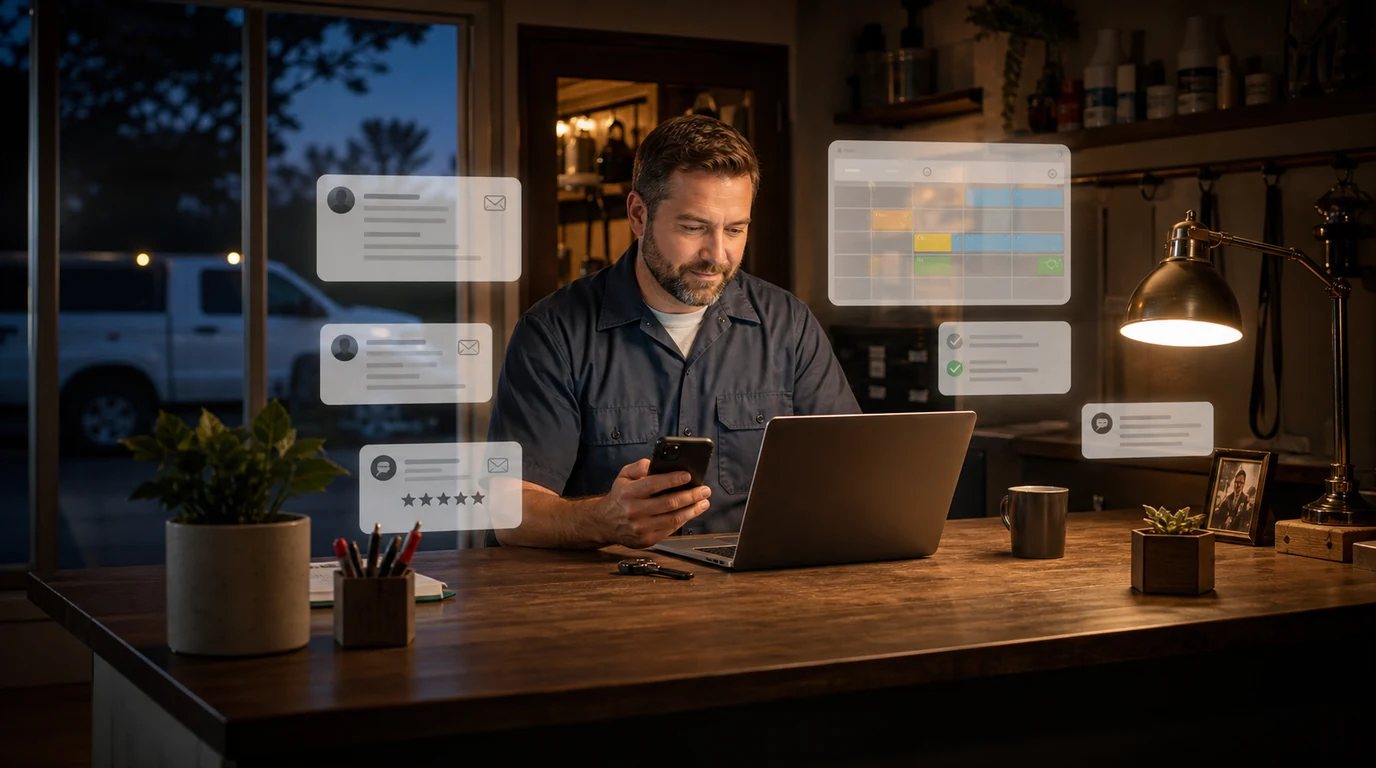
Most small business owners think AI means a chatbot on their website or a robot writing their emails. That is not where the value is. The real advantage is invisible. It is the system running quietly in the background so you stop doing the same task by hand every single day.
Here is what that looks like in practice.
A Law Firm's Intake Line
A missed call is not a small thing for a law firm. Just 40% of firms answer the phone when a prospective client calls, and 48% never call back at all, according to Clio's 2024 Legal Trends Report, based on real calls placed to 500 firms. That gap has a dollar value. WCRI's September 2024 study of nearly a million workers' compensation claims found that attorney representation is worth $7,700 to $12,400 more per case in indemnity benefits alone. A missed call is not a minor inconvenience. It is a five-figure case walking to whichever firm answers next.
Picture a law firm we built an AI intake system for, handling criminal defense and workers' compensation cases.
Before: intake calls that came in after hours, during a hearing, or while staff were on another line went to voicemail. No confirmation, no follow-up text, and a voicemail box is not a safe place to leave that information when someone is in custody or hurt on the job.
After: a phone system now answers every call live, in English or Spanish, 24/7. It runs the firm's real intake process for criminal defense or workers' comp, screens for conflicts of interest, and books the consultation in real time. Every caller gets a text confirmation on the spot. If a call fails to connect, the system texts and calls the person back within thirty seconds, and anything urgent, someone in custody now, a court date within days, a denied comp claim on a deadline, still gets an immediate email straight to the attorney.
The attorney gets more than an alert. Every call ends with an email that summarizes what happened in plain bullet points, along with the caller's name, contact information, and the full transcript, flagged emergency, urgent, or routine. Every intake also lands on a dashboard the firm pulls up anytime, each one with a status, new, contacted, retained, and a button that dials the attorney first and bridges straight to the caller, so reaching out takes one tap instead of digging up a number.
The result: no caller reaches a voicemail box, and no one is left wondering if their consultation is actually booked. Every intake call gets answered, qualified, and confirmed, day or night.
That is the pattern behind real automation. It does not replace the attorney. It replaces the voicemail box, the missed message, and the doubt.
Run the math on just the calls that convert. One or two of those calls becoming a client each month adds up to close to $200,000 a year, cases that used to walk to whichever firm picked up the phone instead.
The Pattern Behind It
AI and automation do not replace your business. They replace the repetitive parts of running it. The parts where a human is doing the same task the same way, over and over, and calling it work.
If you are hiring an admin or a scheduler right now, look closer before you post the job. You might be about to pay someone $35,000 a year to do a job an automated system handles for a fraction of that, without sick days or turnover. That is not a threat to your team. It is a way to point your people at work that actually needs a human, and let the system handle the rest.
Where This Shows Up In Your Business
Every small business has a handful of tasks like this. You may not have named them yet, but you know them when you see them.
- A real estate office manually following up with every lead that goes cold after 48 hours
- An auto dealership's service department retyping the same appointment details into three different systems
- A dental office calling patients one by one to remind them about appointments
- A home services company losing jobs because nobody answered the phone after 6pm
- An insurance agency generating the same quote comparison by hand every time
None of these need a chatbot. They need a system that catches the task before a human has to.
If your customer base includes Spanish-speaking clients, a lot of this work doubles. Bilingual follow-up, bilingual intake, bilingual reminders. A system built correctly the first time saves you real hours every week instead of adding a second manual process on top of the first.
Two Objections Worth Answering
What A Done-For-You Build Actually Looks Like
This is not enterprise software. You do not need a six-figure platform or a technical hire. A real automation build for a business your size looks like this: fixed scope, fixed price, built around the three or four tasks eating the most hours in your week. No hourly billing. No open-ended contract. You know what you are getting and what it costs before you sign anything.
That is how Southern AI Systems works. We start with an AI Diagnostic. We walk through your business, find the repetitive work costing you the most time, and hand you a clear plan for what to automate first and what it will cost to build.
You do not need more software to check. You need fewer things to do by hand.
Find the three tasks costing you the most time
30 minutes. Fixed price. You walk away with a clear plan, whether you build it with us or not.